
Board-Certified Allergist & Immunologist
Blog
Podcast
Podcast
Why “Safe and Effective” Isn’t Enough: Understanding Medical Risk and Benefit
Learn why medical decisions require more than “safe and effective,” including individual risk factors, absolute risk, treatment benefits, and alternatives.

October 24, 2026
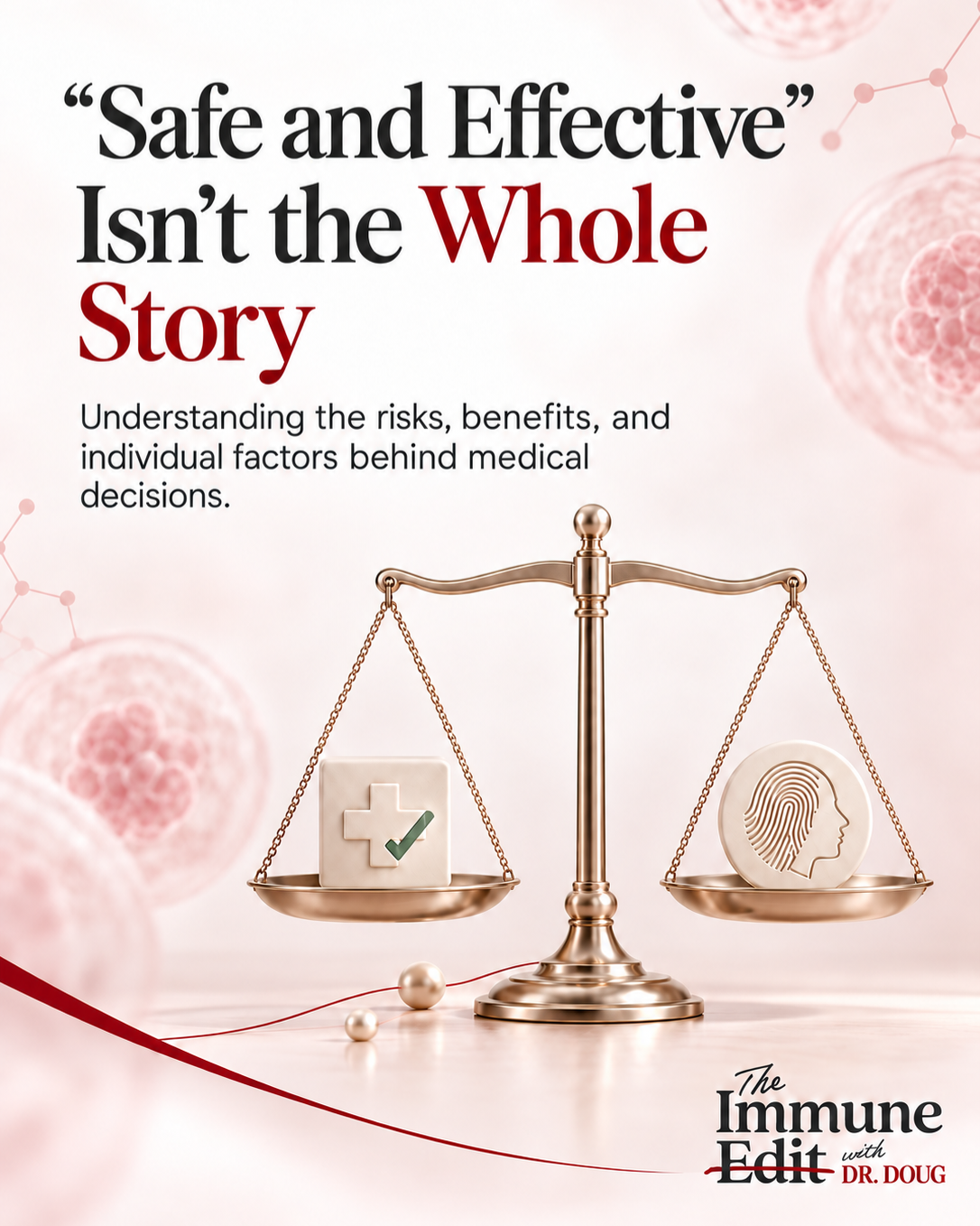
“Safe and effective” is a phrase used constantly in medicine. We hear it when discussing medications, vaccines, procedures, and treatments. It sounds reassuring, clear, and definitive.
But what does it actually mean?
Does safe mean there is no risk? Does effective mean a treatment works equally well for everyone? And how should we make decisions when a treatment has potential benefits and risks, while leaving the condition untreated carries risks of its own?
In this episode of The Immune Edit, Dr. Doug Jones challenges the way these familiar words are often used. His argument is not that safety and effectiveness do not matter. They are essential. Rather, the phrase alone can oversimplify decisions that require a much deeper understanding of the evidence and the individual patient.
Good medical decisions require more than reassurance. They require context.
Safety Is Not the Same as Having No Risk
No medication, procedure, or medical intervention is entirely free of risk. Even commonly used treatments can cause adverse effects, and the likelihood and seriousness of those effects can vary depending on the person and the circumstances.
When a treatment is considered to have an acceptable safety profile, that does not mean nothing bad can happen. It means its potential benefits and known risks have been evaluated in a particular context.
That evaluation involves several questions:
- What benefits does the treatment offer?
- What risks have been identified?
- How serious are those risks, and how frequently do they occur?
- How strong is the evidence supporting the expected benefits and risks?
- Who was included in the studies?
- How long were participants followed?
- What are the alternatives, including not treating the condition?
These questions help turn a broad statement about safety into a meaningful clinical discussion.
The same treatment may be appropriate for one person and less appropriate for another. The goal is not to eliminate every possible risk, which is often impossible, but to understand the risks well enough to make an informed decision.
Context Changes the Risk-Benefit Calculation
Dr. Jones uses an everyday example to explain why context matters: driving a car.
Driving slowly through a neighborhood on a clear afternoon is not the same as driving at high speed during a blizzard. The vehicle has not necessarily changed, but the circumstances have.
Medical decisions work similarly.
A treatment cannot be evaluated properly without considering the condition it is intended to treat, the person receiving it, and the circumstances in which it will be used.
Age, underlying health conditions, immune status, previous reactions, other medications, and the severity of the disease may all affect the balance of potential benefits and risks.
This is why a universal statement such as “this treatment is safe” may not tell a patient enough to make a decision.
A more useful question is: How do the expected benefits and risks compare for this person, in this situation?
Why Oral Immunotherapy Requires Context
Food allergy treatment provides an example of how context can change the meaning of an exposure.
Oral immunotherapy involves administering carefully measured amounts of an allergen under a treatment protocol designed to help modify the immune response over time. Sublingual immunotherapy uses a different route of administration, with the allergen placed under the tongue. For food allergies, sublingual immunotherapy is a less widely available approach than oral immunotherapy, and its clinical availability and regulatory status vary by country and allergen.
These approaches are not the same as accidental exposure to a food allergen.
During an accidental exposure, the amount consumed, timing, environment, and circumstances may be unpredictable. In a supervised immunotherapy program, clinicians can control important variables, including dose, timing, frequency, and dose increases, according to the treatment protocol.
That structure does not eliminate risk. Oral and sublingual immunotherapy can cause allergic reactions and other adverse effects, and their suitability depends on the individual patient and the specific treatment approach.
The distinction is that a structured treatment plan attempts to manage risk rather than leaving exposure entirely to chance.
It is also important to consider the potential consequences of relying on avoidance alone. Avoidance remains an important part of food allergy management, but accidental exposures can still occur. Depending on the patient and the treatment, immunotherapy may offer benefits that should be weighed against its risks.
The appropriate decision requires a discussion with a qualified allergy specialist, including the treatment's goals, limitations, alternatives, and potential adverse effects.
Effectiveness Needs a Clear Definition Too
Just as safety does not mean zero risk, effectiveness does not mean a treatment works equally well for everyone or achieves every possible goal.
Before evaluating whether a treatment is effective, we need to know what it is intended to accomplish.
Is it designed to reduce symptoms? Prevent hospitalization? Lower the risk of a serious outcome? Improve quality of life? Change a laboratory measurement?
Those outcomes are not interchangeable.
A treatment may improve one measure without producing the same degree of improvement in another. Its effects may also differ across patient populations or change over time.
The size of the benefit matters as well.
Relative Risk and Absolute Risk Are Different
Relative risk reduction can make a treatment's effect sound more dramatic than the absolute numbers suggest.
For example, reducing the risk of an outcome from 20% to 10% represents a 50% relative reduction. Reducing a risk from two cases per million to one case per million also represents a 50% relative reduction.
The relative reduction is identical, but the absolute change is very different.
This is why patients need to understand the actual numbers behind a claim, not just the percentage reduction.
A useful discussion should clarify:
- The starting risk
- The risk after treatment
- The absolute difference between the two
- The outcome being measured
- The time period over which the benefit was observed
- How closely the study participants resemble the patient considering treatment
These details provide a more meaningful picture of what a treatment may realistically achieve.
Not All Risks Are Equal
Risk involves more than how frequently an adverse event occurs.
A temporary headache is not equivalent to a serious, lasting injury. A complete risk assessment considers the likelihood of an event, its severity, whether it is reversible, whether it can be recognized early, and whether it can be treated.
It also considers whether certain people may be more susceptible.
Rare adverse events deserve attention, particularly when they are serious. But a rare event should not automatically be treated as common, and the fact that an event is uncommon does not mean it is imaginary.
Both frequency and severity matter.
This distinction is important when interpreting medical studies, news coverage, social media claims, and individual accounts of adverse experiences.
The Risk of Not Treating Matters Too
One of the most important questions in a treatment decision is often overlooked:
What happens if we do nothing?
Patients and clinicians may focus heavily on the potential side effects of a medication or procedure while paying less attention to the consequences of leaving the underlying disease untreated.
But choosing not to treat is not automatically a risk-free option.
Dr. Jones describes a patient with eosinophilic esophagitis (EoE), a chronic inflammatory condition affecting the esophagus. When eosinophilic esophagitis remains inadequately controlled, persistent inflammation can contribute to esophageal remodeling and fibrosis, potentially leading to strictures, progressive dysphagia, and food impaction.
A conversation focused only on medication risks would miss an essential part of the decision: the potential consequences of ongoing disease.
Similar considerations can arise in conditions such as asthma and severe eczema. Treatments may carry risks, but uncontrolled disease can also cause complications and affect quality of life.
This does not mean treatment is always the right choice. Depending on the condition and the patient, monitoring, watchful waiting, or another approach may be reasonable.
The point is that the decision should compare the available options fairly.
Doing nothing is sometimes the best choice, but it should be a considered choice rather than the default simply because treatment feels riskier.
There is no separate category in which doing nothing guarantees zero risk.
Individual Risk Depends on the Person
The same treatment can provide different levels of benefit to different people.
One reason is baseline risk: the likelihood that a person will experience the outcome the treatment is intended to prevent or improve before treatment begins.
If someone's baseline risk is already very low, the absolute benefit of an intervention may be small. For someone at higher risk, the same intervention may offer a more substantial absolute benefit.
The treatment has not changed. The circumstances of the person receiving it have.
Age, health status, previous disease, immune status, prior reactions, other medications, and relevant exposure risks may all influence a clinical decision.
Recommendations may also change as a person's health changes or as better evidence becomes available.
Individualized medicine does not necessarily require expensive genetic testing or extensive panels. Sometimes, it begins with understanding the patient's history, priorities, circumstances, and the evidence relevant to their situation.
The goal is not to find one answer that supposedly fits everyone. It is to determine which option makes the most sense for the person in front of us.
Discussing Vaccine Safety Without Oversimplifying It
Vaccines are an important example of why medical conversations need room for nuance.
Vaccination has prevented illness and saved lives and remains one of the major achievements of modern medicine. Like all medical interventions, vaccines can cause adverse reactions, most of which are mild and self-limited. Serious vaccine-related reactions are uncommon, but their frequency and severity vary by vaccine. An adverse event occurring after vaccination does not necessarily establish causation. Evaluating vaccine safety requires comparing documented risks with the benefits of vaccination and the risks associated with the disease being prevented.
The relevant question is how the benefits and risks compare for a particular vaccine, population, and clinical circumstance.
Recommendations may depend on factors such as age, underlying health conditions, previous reactions, contraindications, precautions, and the risk of the disease being prevented.
Evidence also continues to develop after a medical product is authorized or approved. Clinical trials provide essential information, but they cannot necessarily identify every rare adverse event, particularly when a study is too small to detect it.
That is one reason ongoing safety monitoring matters. Post-marketing surveillance, adverse-event reporting, registries, and additional studies can help identify signals that warrant further investigation.
A reported event following vaccination or another treatment does not, by timing alone, prove that the intervention caused it. Establishing causality requires careful evaluation of the available evidence, including background rates and other possible explanations.
At the same time, potential safety signals should not be dismissed simply because they are uncommon or inconvenient to discuss.
The responsible approach is to investigate credible concerns, communicate what is known, acknowledge uncertainty, and update recommendations when the evidence warrants it.
Changing Recommendations Can Be Part of Good Science
Medical recommendations are based on the evidence available at a particular time. As new data emerge, the balance of benefits and risks may become clearer or change.
Sometimes, a previous recommendation was mistaken and needs correction. At other times, new evidence reveals information that could not reasonably have been established earlier.
Being willing to revise a recommendation is not inherently a sign of failure. Refusing to reconsider a position despite meaningful new evidence can be more concerning.
Good medical practice requires continued evaluation of the evidence, including its limitations.
This also means being transparent about uncertainty. A study may have a limited follow-up period, a narrowly defined population, or criteria that do not fully reflect current understanding. Those limitations matter when deciding how broadly its findings can be applied.
Acknowledging limitations does not make research worthless. It helps clinicians and patients understand what conclusions the evidence can and cannot support.
Why Study Quality and Follow-Up Matter
The phrase “safe and effective” can sound definitive even when the evidence behind a particular claim has limitations.
To evaluate a treatment responsibly, it helps to ask:
- Who participated in the study?
- Who funded the research?
- How were safety and effectiveness measured?
- How long were participants followed?
- Were adverse events reported clearly?
- What limitations did the researchers identify?
- Have other studies produced similar findings?
Funding is relevant context, but it does not by itself determine whether a study is reliable. Likewise, one study rarely settles every question about a treatment.
The strength of a conclusion depends on the overall quality and consistency of the evidence.
Longer-term monitoring can be particularly important when a potential adverse effect may not appear during an initial clinical trial. Evidence gathered after a treatment becomes widely used can add to what was learned before approval or authorization.
The goal is not to assume that every study is flawed. It is to understand the evidence well enough to know what it supports.
Individual Stories Matter, But They Are Not the Whole Evidence
Patients' experiences can play an important role in identifying possible adverse effects or unexpected treatment outcomes.
Sometimes, an individual case is the first signal that prompts further investigation.
Those reports should be taken seriously and assessed appropriately. However, an individual account cannot usually establish how often an event occurs or prove that a treatment caused it.
Researchers need broader data to assess frequency, compare outcomes, investigate causality, and identify potential risk factors.
This is where two important ideas meet:
A story is not a denominator, and a denominator is not a person.
Population-level data help us understand patterns and probabilities. Individual experiences remind us that those numbers represent real people with different circumstances and outcomes.
Good medicine needs both.
The Problem With Fear-Based Medical Messaging
Medical information is often communicated through short headlines, slogans, and social media posts. These formats reward certainty, dramatic claims, and simple explanations.
A nuanced finding may become a claim that a treatment is a cure. A potential risk may be presented as inevitable. An early research signal may be treated as settled science.
This can distort how people understand medical decisions.
Dr. Jones also reflects on the difference between reassurance and understanding. Telling someone not to worry may provide temporary comfort, but it does not necessarily help them understand the decision they are facing.
Meaningful understanding requires a more complete conversation: what the treatment may accomplish, what risks are known, what remains uncertain, what alternatives exist, and what could happen without treatment.
That kind of conversation may be less catchy than a slogan, but it gives patients more useful information.
Better Questions Lead to Better Decisions
Rather than replacing “safe and effective” with another catchy phrase, Dr. Jones argues for asking better questions.
Before starting a treatment, patients and clinicians can discuss:
- What are we trying to accomplish?
- How likely is the treatment to achieve that goal?
- What benefits might someone with this patient's circumstances reasonably expect?
- What are the known risks, and how common and serious are they?
- Are there factors that could make this person more susceptible to adverse effects?
- What are the alternatives, and how do their benefits and risks compare?
- What could happen if we choose not to treat?
- What remains uncertain, and how might new evidence change the decision?
These questions are not a reason to fear every intervention. They are a way to make informed decisions that reflect the available evidence and the patient's circumstances.
The right decision may be to proceed with treatment. It may be to choose an alternative, monitor the condition, or wait. In some cases, the evidence may not provide a clear answer.
A clinician should be able to explain the reasoning behind the recommendation and discuss uncertainty honestly.
Moving From Fear to Understanding
Retiring the phrase “safe and effective” does not mean abandoning the principles it is meant to represent.
Safety matters. Effectiveness matters. But neither word tells the whole story on its own.
The meaningful question is whether the expected benefit justifies the potential risk for a particular person, given the condition being treated, the evidence available, and the alternatives—including doing nothing.
That requires context, transparent communication, and a willingness to keep learning.
It also requires recognizing that evidence can evolve. Medical decisions should reflect what is reasonably known now, while remaining open to change when better evidence becomes available.
The goal is not to make people more afraid of medicine. It is to help them understand it more clearly.
Instead of relying on blanket reassurance, we need better questions, better conversations, and decisions grounded in evidence and individual circumstances.
As Dr. Jones emphasizes, the goal is to move from fear toward understanding.
Frequently Asked Questions
Does “safe and effective” mean a treatment has no risks?
No. In medicine, a favorable safety profile does not mean a treatment is completely risk-free. It means the known and potential risks have been evaluated in relation to the expected benefits, the condition being treated, and the available evidence.
What is a risk-benefit assessment in medicine?
A risk-benefit assessment compares the expected benefits of a treatment with its potential harms in a particular clinical context. It considers factors such as the condition's severity, the patient's health and risk factors, the quality of the evidence, and the available alternatives.
Why does context matter when evaluating a medical treatment?
A treatment's benefits and risks can differ depending on the person receiving it and the condition being treated. Age, underlying health, previous reactions, other medications, baseline risk, and the treatment's intended purpose can all affect whether it is appropriate.
What is the difference between relative risk reduction and absolute risk reduction?
Relative risk reduction describes the proportional decrease in risk compared with the starting risk. Absolute risk reduction describes the actual difference in the probability of an outcome. Both are useful, but absolute numbers help patients understand how much the risk changes in practical terms.
Is doing nothing a risk-free option?
No. Choosing not to treat may avoid treatment-related adverse effects, but the underlying condition may continue or worsen. In some circumstances, monitoring or watchful waiting is appropriate. The decision should account for both the potential consequences of treatment and the potential consequences of leaving the condition untreated.
Can a treatment be appropriate for one person but not another?
Yes. People may have different baseline risks, medical histories, underlying conditions, and treatment goals. A treatment that offers meaningful benefit to one person may offer less benefit or present different risks to another. Individualized clinical assessment helps guide these decisions.
Does an adverse event after vaccination or medication prove the treatment caused it?
No. An event that occurs after a treatment may be related to it, but timing alone does not establish causation. Evaluation may require looking at background rates, other possible explanations, patterns across multiple reports, and findings from appropriate studies. Credible safety signals should be investigated.
Why can medical recommendations change over time?
Recommendations may change when new evidence clarifies a treatment's benefits, identifies additional risks, or changes the understanding of a disease. Updating guidance in response to meaningful evidence is part of responsible medical practice.
Why is long-term safety monitoring important?
Clinical trials provide important information but may not be large enough or long enough to identify every rare or delayed adverse event. Post-marketing surveillance, registries, adverse-event reports, and additional studies can provide further evidence about a treatment's safety.
What questions should patients ask before starting a treatment?
Patients can ask what the treatment is intended to achieve, how likely it is to help, what risks are known, whether personal risk factors matter, what alternatives exist, and what could happen without treatment. They should also ask what remains uncertain and discuss how the decision applies to their individual circumstances with a qualified healthcare professional.
Medical Disclaimer: This article is for educational and informational purposes only. It is not a substitute for professional medical advice, diagnosis, or treatment. The discussion reflects the themes of the The Immune Edit episode and should not be interpreted as an individualized recommendation for any medication, vaccine, procedure, or other intervention. Treatment decisions should be made with a qualified healthcare professional who can consider your medical history, circumstances, and available evidence. Do not start, stop, or change a prescribed treatment without consulting your healthcare provider.