
Board-Certified Allergist & Immunologist
Blog
Podcast
Podcast
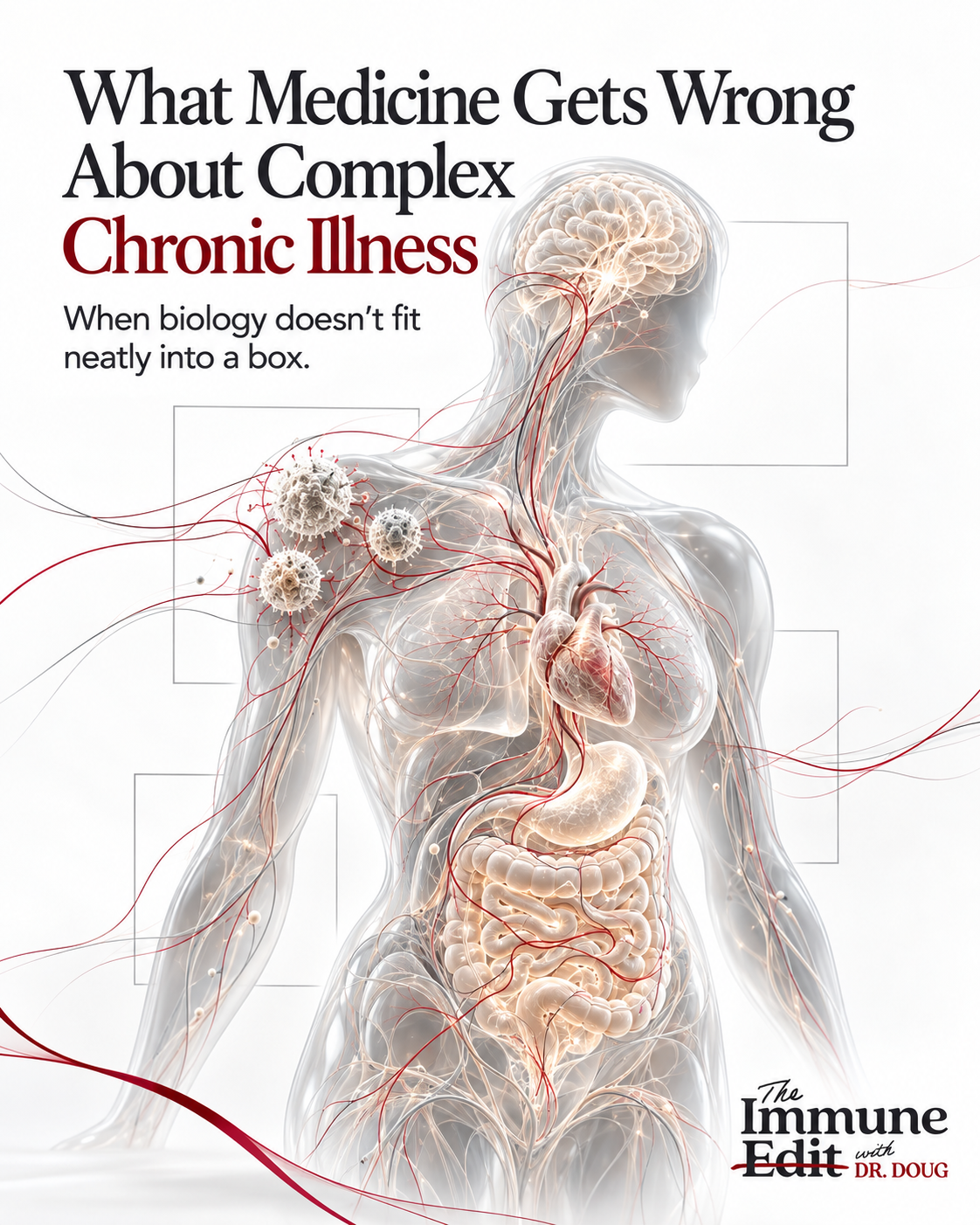
What Medicine Gets Wrong About Complex Chronic Illness
Why complex chronic illness can fall through the cracks of modern medicine—and how better care can connect clinical practice, research, education, and access.

October 10, 2026
After nearly two decades as a board-certified allergist and immunologist, Dr. Doug Jones is entering a new chapter in his career as Medical Director at the Bateman Horne Center.
For Dr. Jones, this is more than a change in where he practices medicine. It reflects a larger question that has shaped much of his work: How do we care for people whose biology does not fit neatly into the boxes medicine has built?
That question is especially important for people living with complex chronic illnesses, including ME/CFS, Long COVID, dysautonomia, mast cell disorders, fibromyalgia, and other conditions that can involve multiple interacting systems.
The answer, Dr. Jones argues, requires both scientific rigor and compassion. It means taking patients seriously without assuming that every proposed mechanism is correct. It means recognizing uncertainty without allowing uncertainty to become an excuse for dismissal.
And above all, it means focusing on the person rather than forcing the person to fit the label.
A New Chapter With the Same Mission
Dr. Jones's clinical work has included patients with food allergy, hereditary angioedema, mast cell disorders, and other allergic and immunologic conditions.
That work is not going away.
His practice is transitioning with him, allowing him to continue caring for patients with these conditions while expanding his work into a broader model of complex chronic care.
The move also brings together several areas that have been central to his career: clinical care, research, patient and clinician education, and access to expertise.
This is closely aligned with the philosophy behind The Immune Edit: moving people from fear toward understanding.
Rather than offering a simple explanation for every complicated illness, the goal is to understand what is known, what remains uncertain, and which biological mechanisms may actually be involved.
Human biology rarely follows a simple script.
Medicine Likes Boxes. Biology Does Not.
Modern medicine is organized around specialties for good reasons. Allergists treat allergic disease. Cardiologists focus on the cardiovascular system. Neurologists evaluate disorders of the nervous system. Gastroenterologists focus on the gastrointestinal tract.
But the body's systems do not operate independently.
The immune system communicates with the nervous system. The nervous system interacts with the cardiovascular system. The gut communicates with multiple other systems. Hormones influence physiology across the body. Sleep, metabolism, vascular function, and autonomic regulation can all affect one another.
An infection or another significant physiological stressor can also affect several systems at the same time.
That does not mean every symptom has one unifying explanation.
It also does not mean that every abnormality is immune-mediated.
It means that complexity requires us to become more rigorous, more curious, and more careful, not less.
For patients whose symptoms cross traditional specialty boundaries, however, the healthcare system can make that difficult.
Care may be fragmented between specialists. Appointments can be short. Insurance structures can create additional barriers. Patients may end up coordinating multiple pieces of their own care while trying to determine which specialist can address which part of the problem.
The result can be a system that is organized around medical categories even when the patient's biology does not fit neatly into one.
Taking Complex Illness Seriously
The Bateman Horne Center has spent decades focusing on complex illnesses such as ME/CFS, including clinical care, research, education, and efforts to better understand the biology of these conditions.
For Dr. Jones, joining the organization represents an opportunity to build on that foundation rather than replace it.
It also creates an opportunity to ask a broader question:
What could the next model of complex chronic care look like?
Several patient populations frequently overlap in clinical practice, including people with ME/CFS, Long COVID, other post-infectious syndromes, fibromyalgia, POTS and other forms of dysautonomia, mast cell disorders, and patients with combinations of immune, allergic, inflammatory, neurologic, gastrointestinal, vascular, and autonomic symptoms.
These conditions are not interchangeable diagnoses.
They do not necessarily share one mechanism, and grouping them all into a single category would risk losing important differences.
At the same time, patterns of overlap and clustering may provide important research questions.
The goal, therefore, is not to erase the diagnostic labels. It is to use them appropriately while asking what is happening biologically in the individual person.
The Label Matters. The Person Matters More.
A diagnosis gives clinicians a framework for communication, evaluation, and research.
Good definitions and careful phenotyping are also essential when studying complex illnesses. Researchers need to know who they are studying and how different groups of patients compare.
But a diagnosis should help us understand the person. The person should not have to conform perfectly to the diagnosis.
Two people with the same diagnosis may have very different dominant symptoms, triggers, disease trajectories, coexisting conditions, and responses to treatment.
That variability should not automatically be dismissed as noise.
Sometimes, variability is a signal.
It may reflect different biological subgroups, different stages of illness, different contributing mechanisms, or several biological pathways converging on similar symptoms.
At present, we do not always know which explanation applies.
And "we don't know yet" is an important scientific answer.
It is not a failure. It can be the beginning of a better research question.
From the Label to the Mechanism
Instead of asking only, "What diagnosis does this patient have?" complex care may also require questions such as:
- What systems appear to be involved?
- Which mechanisms are supported by evidence?
- What can reasonably be treated?
- What other conditions need to be considered?
- What is realistic for this particular patient?
- What do we still need to learn?
This approach does not reject diagnostic labels. It adds another layer of thinking.
The label provides structure.
The phenotype provides detail.
The underlying biology provides questions.
The patient provides the context in which all three have to make sense.
"Am I the Wrong Kind of Sick?"
Dr. Jones recalls a patient who was experiencing meaningful benefit from a medication but repeatedly faced insurance barriers to accessing it.
After denials, appeals, meetings, and continued obstacles, the patient eventually asked a question that stayed with him:
"Am I just the wrong kind of sick?"
For Dr. Jones, the answer was no.
The problem was not that the patient was the wrong kind of sick. The problem was that the system was not well designed to care for the complexity of her illness.
That experience reflects a broader problem faced by many people with chronic illness.
Patients may wonder:
What if my disease is not the one receiving attention right now?
What if my tests do not clearly explain what I am experiencing?
What if I do not fit the diagnostic criteria perfectly?
What if I cannot access a clinician with experience in my condition?
These questions are not simply medical questions. They can shape how people experience the healthcare system and whether they feel heard within it.
Taking a patient seriously, however, does not mean promising an answer that medicine does not yet have.
It means being willing to say:
"I don't know yet, but I believe what you're experiencing, and we're going to approach it systematically."
Compassion and Scientific Rigor Must Work Together
There is a false choice that sometimes appears in discussions about complex chronic illness: either we prioritize compassion or we prioritize scientific rigor.
Dr. Jones argues that we need both.
Compassion without scientific rigor can lead to unsupported explanations and treatments.
Scientific rigor without compassion can lead to patients being dismissed simply because their illness is difficult to characterize.
Good medicine requires the two to operate together.
We can acknowledge that a patient is suffering without assuming that every proposed explanation is correct.
We can recognize that a biological mechanism is plausible without presenting it as proven.
We can say that research has not yet answered a question without concluding that there is nothing happening.
Uncertainty should not become an excuse for dismissal.
Building Connections Between Clinical Care and Research
One of the central ideas behind this next chapter is bringing clinical care and research closer together.
Clinicians see the heterogeneity of complex illness every day.
Patients with the same diagnosis can have very different symptoms, triggers, trajectories, comorbidities, and treatment responses.
Those differences can generate research questions.
What are clinicians repeatedly seeing?
Can those patterns be characterized?
Can they be measured?
Can they be tested?
And, most importantly, can what is learned ultimately improve the life of the patient sitting in front of us?
This creates a two-way relationship:
Clinical care → research questions → new evidence → better clinical care
Research should inform practice, while clinical experience should help identify the questions that research needs to answer.
That requires discipline.
Some proposed mechanisms will prove correct. Others may turn out to be partly correct. Some may eventually be shown to be wrong.
That is not a problem with science.
That is how science works.
Anecdotes Can Generate Questions, But They Are Not Proof
Patients' experiences matter.
Anecdotes can reveal patterns that deserve investigation and can help clinicians recognize questions that may otherwise be overlooked.
But an individual experience does not establish that a treatment works for everyone or that one mechanism explains an entire disease.
The responsibility is to take the signal seriously while still evaluating it scientifically.
The goal is not to fall in love with a particular mechanism.
The goal is to follow the evidence wherever it leads.
Expanding Access to Expertise
Expertise is often geographically concentrated while patients are spread across large regions.
For someone living with significant post-exertional malaise, autonomic symptoms, or another complex chronic condition, traveling long distances simply to see a specialist can itself be difficult.
Telehealth and other technologies create an opportunity to bring specialized knowledge closer to patients.
That does not mean replacing in-person medicine.
Some evaluations require physical examinations, testing, procedures, emergency care, or other hands-on assessment.
Instead, the goal is to strengthen the patient's existing healthcare ecosystem.
Specialty expertise can help patients and their local clinicians make sense of complicated histories, prioritize evaluations, identify potentially treatable contributors, and develop more rational care plans.
A better system should meet patients where they are whenever possible.
Education Is Part of the Solution
Access cannot be solved simply by having a small number of specialists see more patients.
There are too many patients and too few clinicians with substantial experience in these conditions.
Education therefore becomes an important part of the model.
Primary care clinicians, allergists, immunologists, cardiologists, neurologists, nurse practitioners, physician assistants, physical and occupational therapists, psychologists, psychiatrists, dietitians, and other healthcare professionals may all encounter patients with complex chronic illness.
Not every clinician needs to become an ME/CFS or Long COVID specialist.
But more clinicians should be comfortable recognizing important concepts such as post-exertional malaise and orthostatic intolerance.
They should also understand that a standard laboratory evaluation that does not identify an abnormality does not necessarily explain every symptom a patient is experiencing.
Sometimes, an important clinical step is simply being able to say:
"I don't know exactly what is happening yet, but I believe what you're experiencing, and we're going to approach it systematically."
That can change a patient's experience of healthcare.
Patients Need Better Information Too
Education is not only for clinicians.
Patients living with complex illness are often navigating an overwhelming amount of information, especially online.
Some of that information is thoughtful and evidence-based.
Some of it is based on emerging research.
And some of it is built around fear, certainty, and the promise of a single explanation or solution.
Complex illness creates particular vulnerability to those messages.
Patients deserve information that distinguishes:
- What is established from what is emerging
- What is plausible from what is proven
- What is known from what is still uncertain
- What may apply to some patients from what can be generalized to everyone
This is also why Dr. Jones cautions against broad claims about "immune boosting" or "immune support."
The immune system is not a simple system that universally needs to be increased. Immune function is complex, highly regulated, and context-dependent.
When a product or treatment is presented as a universal answer to a complicated biological problem, skepticism is warranted.
Avoiding the "Everything After an Infection" Bucket
Post-infectious illness has become an increasingly important area of medical research, particularly as Long COVID has brought greater attention to persistent symptoms following infection.
But not every patient with Long COVID has ME/CFS.
Not every person with fatigue has ME/CFS.
Not every episode of tachycardia represents POTS.
Not every unexplained symptom is autoimmune.
And not every unexplained symptom is caused by histamine or a mast cell disorder.
These distinctions matter.
Overgeneralizing can be just as problematic as dismissing the symptoms altogether.
The goal is to understand where conditions overlap, where they differ, and which biological mechanisms are actually supported by evidence in a particular patient or population.
What Could a Better Model Look Like?
For Dr. Jones, the long-term goal is not simply building a larger clinic.
It is demonstrating that there may be a better way to care for people with complex chronic illness.
That model would connect several areas:
Clinical care
Patients receive thoughtful, individualized evaluation and care.
Research
Clinical observations generate research questions, and research findings return to clinical practice.
Education
Clinicians receive the knowledge and tools they need to better recognize and care for complex conditions.
Access
Telehealth, professional networks, and technology help extend specialized expertise beyond a single geographic location.
These pieces should not exist in isolation.
The goal is to connect them.
Instead of another isolated center of expertise, the vision is a network in which clinicians can learn from one another, patients can access appropriate expertise, and research can inform care more directly.
The Importance of Learning From Different Patient Populations
Complex chronic illnesses may share certain biological features without being the same disease.
Studying different patient populations can therefore help researchers identify both common mechanisms and meaningful differences.
The challenge is maintaining enough specificity to avoid collapsing distinct conditions into one diagnosis while remaining open to the possibility that some biological pathways overlap.
That balance matters.
We should not assume that every patient has the same mechanism.
But we should also not ignore potentially important connections simply because traditional diagnostic categories keep conditions in separate boxes.
A Different Way of Thinking About Complex Illness
A better model of care does not require having every answer.
In fact, one of its defining features may be the ability to acknowledge what remains unknown while continuing to investigate it.
The distinction is important:
"We don't know everything yet" keeps the door open to science.
"There is nothing here to understand" closes it.
Complexity should not lower the standard of evidence.
It should raise it.
It should encourage better phenotyping, better research questions, better communication between specialties, and more careful interpretation of emerging evidence.
Building on What Already Exists
Dr. Jones also recognizes that he is entering a field where researchers, clinicians, advocates, caregivers, and patients have already spent decades building knowledge and pushing for better care.
The Bateman Horne Center has developed substantial expertise, infrastructure, research, educational resources, and trust within the complex chronic illness community.
Joining that work does not mean starting over.
It means contributing another area of expertise, particularly from an immunology and complex multi-system disease perspective, while recognizing how much there is still to learn.
Being a medical director does not mean having every answer.
It means helping create an environment where better questions can be asked, evidence can be followed, clinical practice can evolve, and patients remain at the center of the work.
Keeping the Patient at the Center
Ultimately, the model Dr. Jones describes is about connection.
Clinical care should inform research.
Research should inform clinical care.
Education should multiply what clinicians learn.
Technology should expand access to expertise.
And scientific rigor should work alongside compassion rather than being treated as its opposite.
The goal is not to create another silo for complex chronic illness.
It is to help connect the silos.
For patients who have spent years feeling as though they do not fit neatly into the healthcare system, that distinction matters.
The question is not whether medicine already has every answer.
It is whether we are willing to keep asking better questions.
From "Am I the Wrong Kind of Sick?" to "What Do We Need to Understand?"
The patient question Dr. Jones remembers most is still relevant:
"Am I the wrong kind of sick?"
It is a question that can emerge when an illness is poorly understood, when testing does not fully capture a patient's experience, when a condition receives little attention, or when the healthcare system has no convenient place for someone to fit.
But patients should not have to earn care by having the perfect diagnosis.
Labels matter. Diagnostic criteria matter. Evidence matters.
But so does the person behind the label.
The next chapter of The Immune Edit will continue exploring that tension: how to take complex illness seriously without oversimplifying it, how to remain open to emerging science without treating hypotheses as facts, and how to move from fear toward understanding.
Because the goal is not to make complicated biology sound simple.
The goal is to make it understandable without losing the complexity that matters.
Frequently Asked Questions
Why is Dr. Doug Jones joining the Bateman Horne Center?
Dr. Jones is joining the Bateman Horne Center as Medical Director as part of a broader effort to connect clinical care, research, education, and access for people living with complex chronic illness. His existing clinical work in allergy and immunology will continue as his practice transitions with him.
Will Dr. Jones continue treating allergy and immunology patients?
Yes. His clinical work with food allergy, hereditary angioedema, mast cell disorders, and other allergic and immunologic conditions will continue as part of this transition.
What does complex chronic illness mean?
Complex chronic illness can involve symptoms or biological processes that span multiple body systems and do not always fit neatly within one medical specialty or diagnostic category. Examples discussed in this episode include ME/CFS, Long COVID, dysautonomia, POTS, fibromyalgia, and mast cell disorders, although these are distinct conditions and should not automatically be treated as interchangeable.
Are ME/CFS, Long COVID, POTS, and mast cell disorders the same condition?
No. These are distinct diagnoses or clinical entities, and they do not necessarily share one underlying mechanism. However, some patients may experience overlapping symptoms or coexisting conditions, making careful evaluation and phenotyping important.
Why does Dr. Jones emphasize individual treatment rather than a one-size-fits-all approach?
People with the same diagnosis can have different symptoms, triggers, coexisting conditions, disease trajectories, and treatment responses. An individualized approach considers which systems and mechanisms appear to be involved in that particular person rather than assuming one explanation applies to everyone.
Does telehealth replace in-person medical care?
No. Telehealth can expand access to specialized expertise, but some evaluations, examinations, testing, procedures, and urgent medical care require in-person assessment. The goal is to strengthen local healthcare rather than replace it.
Why is clinician education important for complex chronic illness?
There are more patients with complex chronic illness than there are clinicians with extensive experience treating these conditions. Improving education can help more healthcare professionals recognize important clinical features, understand basic concepts such as post-exertional malaise and orthostatic intolerance, and know when to seek additional expertise.
Does a normal laboratory test mean nothing is wrong?
Not necessarily. A standard laboratory evaluation may not capture every physiological process involved in a complex illness. However, this should not be interpreted as proof of a specific hidden disease or mechanism. Careful clinical evaluation and evidence-based investigation remain important.
Why does Dr. Jones caution against "immune boosting"?
The immune system is a complex, highly regulated system, and there is no general principle that everyone needs their immune system "boosted." Broad claims that a product or treatment can universally improve immune function should be approached cautiously and evaluated against the available evidence.
What role do patients play in research?
Patients provide important clinical observations and lived experience that can help identify patterns and generate research questions. However, individual experiences and anecdotes do not by themselves establish that a treatment works broadly or prove a particular mechanism. They are signals that require systematic investigation.
Medical Disclaimer: This article is for educational and informational purposes only and is not a substitute for professional medical advice, diagnosis, or treatment. The information discussed does not constitute medical or other professional services. Individual conditions and treatment needs vary. If you have concerns about your health or are experiencing persistent or complex symptoms, consult a qualified healthcare professional.