
Board-Certified Allergist & Immunologist
Blog
Podcast
Podcast
Two Things Can Be True: Why Medicine Needs More Nuance
Why medical answers aren't always simple. Learn why symptoms can be real, explanations can be wrong, and context and evidence matter in healthcare.

August 28, 2026
%20(1).PNG)
Medicine is rarely as simple as social media makes it seem.
A symptom can be real without the explanation attached to it being correct. A treatment can help many people while causing problems for others. A test can come back normal while a patient is still genuinely unwell. And medical care can sometimes fail to recognize someone's suffering while an explanation found online can still be inaccurate.
These aren't contradictions. They are examples of why context, evidence, and nuance matter in medicine.
When health information is reduced to short videos, dramatic headlines, and absolute claims, patients are often pushed toward choosing sides: conventional or alternative, doctor or influencer, safe or dangerous, real or fake. But biology doesn't organize itself according to those categories.
Sometimes, two things can be true at once.
Why Medical Answers Aren't Always Simple
When something happens to our health, it is natural to want a clear explanation.
If a new symptom appears after an infection, medication, vaccine, or another medical event, we may immediately look for a connection. If a laboratory test is abnormal, we may assume it explains everything. If a test is normal, we may assume nothing is wrong.
But the relationship between an event and a symptom is not always straightforward.
Good medical reasoning involves asking questions such as:
- What happened?
- When did it happen?
- To whom did it happen?
- Was there a consistent pattern?
- What mechanisms could explain it?
- What does the available evidence show?
- Could something else explain the symptoms?
- Does the timing actually support the proposed connection?
These questions may not provide the instant certainty that social media promises, but they are essential to understanding what is actually happening.
A Symptom Can Be Real Even When the Explanation Is Wrong
One of the most important distinctions in medicine is the difference between validating someone's experience and validating a particular explanation for that experience.
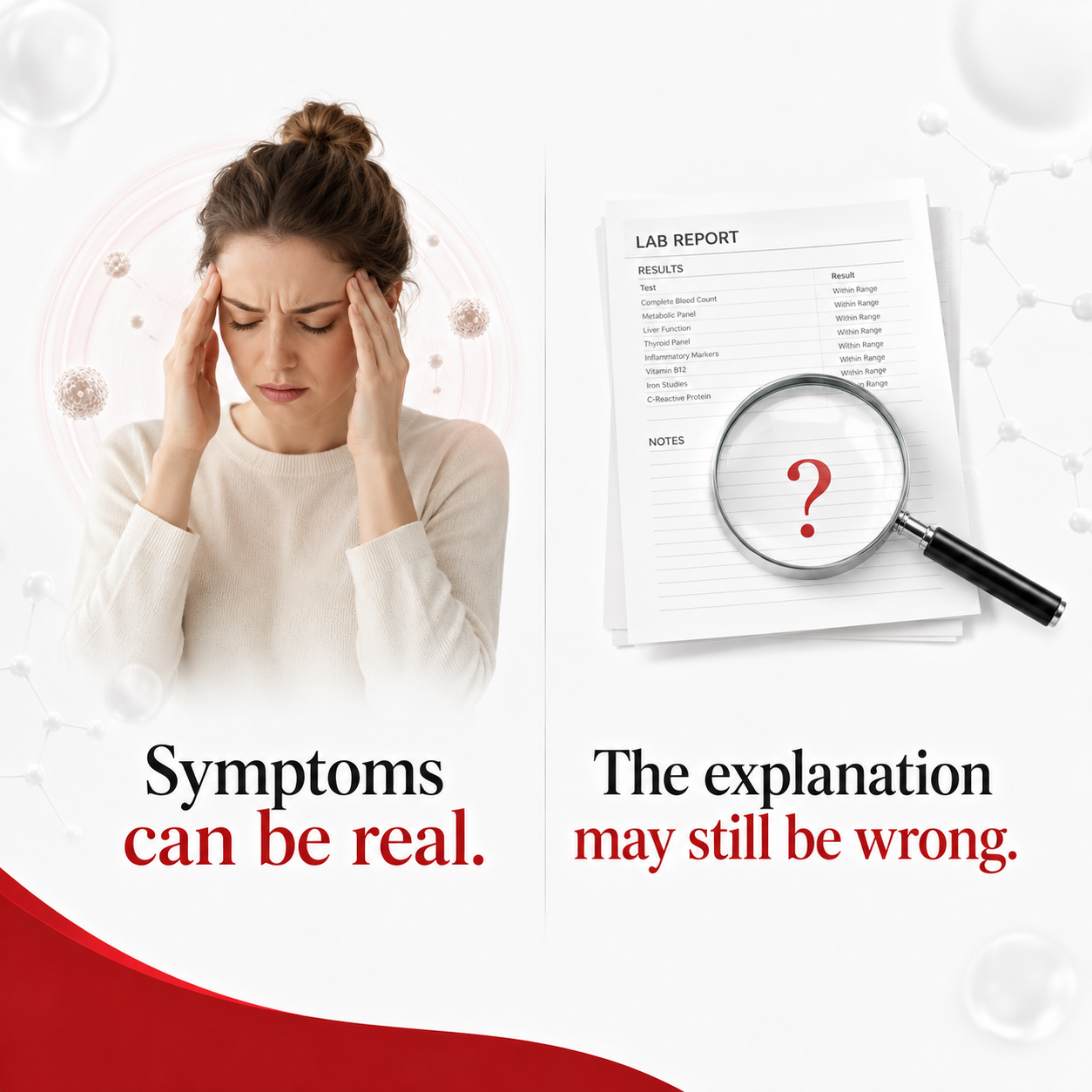
A patient can genuinely be suffering. Their pain, fatigue, dizziness, rash, gastrointestinal symptoms, or other concerns may be completely real.
That does not automatically mean that the first explanation they encounter is the correct one.
For example, a person may develop symptoms after an infection or medication and reasonably wonder whether the two events are connected. That possibility deserves thoughtful consideration. But establishing whether there is actually a causal relationship requires more than timing alone.
Taking someone's symptoms seriously means being willing to investigate them—not automatically accepting every explanation offered for them.
A Normal Test Doesn't Always Mean Nothing Is Wrong
Laboratory tests are valuable tools, but they are only one part of medical evaluation.
A normal result does not necessarily mean that a person has no health problem. Tests have limitations, and their meaning depends on factors such as the test itself, the timing, the person's symptoms, and the clinical situation.
At the same time, an abnormal result does not necessarily explain every symptom a person is experiencing.
This is why interpreting a single laboratory result without context can be misleading.
The better question is not simply:
"Is the test normal or abnormal?"
It is:
"What does this result mean in the context of this particular person?"
Context Changes the Meaning of Medical Information
Medical information rarely exists in isolation.
The same symptom can have different explanations depending on the person's age, medical history, medications, timing, exposures, and other symptoms.
Likewise, the significance of a laboratory result can change depending on why the test was ordered and what else is happening clinically.
This is why physicians often ask questions that may seem repetitive or answer questions with "it depends."
That isn't necessarily an attempt to avoid giving an answer.
Sometimes, "it depends" is the medically responsible answer because the context determines what the information actually means.
The Problem With One-Size-Fits-All Health Claims
Social media rewards certainty.
Statements such as:
- "This is the real cause."
- "Doctors don't want you to know this."
- "This test will tell you everything."
- "This treatment fixes the problem."
- "If you have this symptom, you have this condition."
are attention-grabbing because they offer simple answers to complicated questions.
But complicated biology rarely follows a one-sentence formula.
The more confident a claim sounds, the more important it can be to ask what evidence supports it and whether that evidence applies to the individual situation.
A compelling explanation is not necessarily an accurate explanation.
Compassion and Evidence Belong Together
There is an important balance to maintain in healthcare.
Compassion without evidence can drift into misinformation.
But evidence without compassion can become dismissal.
Patients need both.
Someone who is experiencing unexplained symptoms deserves to be heard. If conventional testing doesn't immediately provide an answer, that does not mean the person's experience should simply be dismissed.
At the same time, feeling heard should not require accepting an unsupported diagnosis or explanation.
A thoughtful approach can say:
"I believe that you are suffering. Now let's work carefully to understand why."
That approach leaves room for uncertainty without abandoning the patient.
When Medicine Doesn't Have the Answer Yet
Medicine is constantly evolving.
Sometimes patients experience patterns that aren't yet fully understood. New observations may begin as individual experiences or case reports before researchers can study them more systematically.
The absence of an established explanation does not automatically mean that someone's symptoms aren't real.
But uncertainty also doesn't mean that the first proposed explanation must be correct.
There is an important difference between saying:
"We don't know yet."
and saying:
"We know exactly what caused this."
The first acknowledges uncertainty. The second requires evidence.
Good medicine should be comfortable with the first when the evidence does not yet support the second.
Why Fear Can Make Certainty Feel Necessary
Health problems can make the world feel unpredictable.
When your body suddenly behaves in a way you don't understand, it is natural to search for an explanation. Uncertainty can feel uncomfortable, while a definite answer can create a sense of safety—even when that answer has not been adequately established.
This can lead people toward simple categories:
- Safe or dangerous
- Good or bad
- Truth-teller or liar
- Doctor or influencer
- Conventional or alternative
But the human body doesn't necessarily fit into those categories.
Fear does not make people unintelligent. It can simply make certainty feel especially attractive.
Recognizing this can help us pause before accepting an explanation simply because it makes uncertainty feel easier to tolerate.
Not Every Symptom Has the Same Cause
Symptoms need to be interpreted in context.
For example, not every episode of fatigue necessarily has the same underlying cause. Not every symptom occurring after an infection was necessarily caused by that infection. Not every symptom following a vaccine was necessarily caused by the vaccine.
Similarly, a symptom in someone with an existing condition does not automatically mean that condition is responsible for it.
Even in someone with a known allergy, for example, not every episode of sneezing necessarily comes from a food exposure.
This doesn't mean potential connections should be ignored.
It means they should be investigated rather than assumed.
Timing, patterns, mechanisms, dose, baseline health, and other circumstances can all matter.
Vaccines: Holding Two Realities at Once
Vaccines provide an important example of why medical nuance matters.
Vaccination has prevented substantial illness and death. At the same time, vaccines can be associated with adverse events, and some reactions can be significant.
These statements can both be true.
People who experience concerning symptoms after vaccination deserve thoughtful medical evaluation. Their concerns should not automatically be dismissed simply because vaccines provide substantial benefits at a population level.
But acknowledging that adverse events can occur does not mean that every symptom occurring after vaccination was necessarily caused by the vaccine.
Both the benefits and potential risks can be discussed honestly without abandoning evidence.
Feeling Heard Isn't the Same as Being Accurately Guided
When people feel dismissed by healthcare professionals, the internet can provide something that medicine sometimes fails to provide: a sense that someone understands them.
That feeling matters.
But there is a potential danger when being understood becomes confused with receiving an accurate medical explanation.
An online source may confidently attribute symptoms to a particular mechanism, condition, toxin, infection, or exposure. The explanation may sound convincing, particularly when it is supported by anecdotes or preliminary research.
But an explanation can be emotionally reassuring without being scientifically established.
The goal should not be to choose between compassion and accuracy.
Patients deserve both.
How to Evaluate Health Claims Online
The next time you encounter a confident medical claim online, try approaching it like a referee reviewing a play.
Don't immediately dismiss it.
But don't automatically award it the "foul," either.
Instead, ask:
What actually happened?
Separate the observation from the interpretation.
When did it happen?
Timing can provide important information, but timing alone doesn't necessarily establish causation.
What is the proposed mechanism?
Does the explanation make biological sense, and is there evidence supporting that mechanism in humans?
What does the evidence show?
Look beyond individual anecdotes and consider the quality and amount of available evidence.
What else could explain it?
A good explanation should account for alternative possibilities rather than assuming there is only one.
Does the claim fit the individual situation?
Population-level findings and laboratory research may provide useful information, but they don't automatically explain every person's experience.
Nuance Does Not Mean Everything Is Equally True
There is an important misconception about nuance.
Being nuanced does not mean saying that every claim deserves equal consideration.
It does not mean:
"Maybe everything is true."
It means evaluating different claims according to the evidence supporting them.
Some explanations have strong evidence behind them. Others have limited evidence. Some remain uncertain. And some are contradicted by available evidence.
Nuance means being willing to recognize those differences rather than forcing every question into an all-or-nothing answer.
Treat People, Not Slogans
Perhaps the most important principle is that healthcare should focus on the individual person.
A person sitting in front of a clinician is more complicated than a social media label, a laboratory value, or a trending diagnosis.
Good medical care requires listening to the patient's experience while also evaluating that experience critically and scientifically.
That means asking questions, considering context, examining evidence, and remaining open to the possibility that our first explanation may not be the right one.
It also means being willing to say:
"Your symptoms are real, and we don't yet know exactly what caused them."
That isn't a failure.
Sometimes, it is the most honest starting point for finding the answer.
Becoming More Comfortable With Uncertainty
The goal of good medical reasoning isn't always to eliminate uncertainty immediately.
Sometimes, the better goal is to become more comfortable with uncertainty while continuing to investigate.
We don't need to choose a side simply because uncertainty makes us uncomfortable.
Instead, we can ask better questions, seek qualified medical guidance, examine evidence, and remain willing to change our understanding as new information becomes available.
That approach may not be as exciting as a dramatic social media claim, but it is much closer to how medicine actually works.
Conclusion
Two things can be true at once.
A patient can be genuinely suffering while the explanation they found online is wrong. Medicine can provide extraordinary benefits while still making mistakes. A treatment can help many people while causing harm in some circumstances. A test can be normal while a patient remains unwell.
Recognizing these realities doesn't weaken medical thinking. It strengthens it.
The goal isn't to dismiss patients, blindly trust every medical claim, or treat every explanation as equally valid. The goal is to listen carefully, evaluate evidence, understand context, acknowledge uncertainty, and remain open to learning.
In a world filled with oversimplified health information, one of the most valuable skills we can develop is the ability to pause before choosing a side.
Listen without surrendering critical thinking. Question without becoming cynical. Acknowledge suffering without automatically accepting every explanation.
Sometimes, two things really can be true at once.
Frequently Asked Questions
Can my symptoms be real even if my test results are normal?
Yes. A normal test does not automatically mean that nothing is wrong. Tests have limitations, and their interpretation depends on the broader clinical context, including symptoms, timing, and other findings.
Does a symptom occurring after an event prove that the event caused it?
No. Timing can be an important clue, but it does not by itself establish causation. Determining whether two events are connected requires consideration of patterns, mechanisms, evidence, and alternative explanations.
Why does medical advice often depend on context?
People differ in their medical history, symptoms, medications, exposures, timing, and baseline health. The same test result or symptom can therefore have different meanings in different situations.
Should I trust medical information I find on social media?
Social media can contain useful information, but confident presentation does not guarantee accuracy. Consider the source, evidence, proposed mechanism, alternative explanations, and whether the information actually applies to your circumstances.
Does being skeptical of a medical claim mean I don't believe the patient?
No. You can take someone's symptoms and concerns seriously while still questioning whether a particular explanation is correct. Listening to a patient and evaluating evidence should happen together.
What does medical nuance mean?
Medical nuance means recognizing that complex health questions may have more than one relevant truth. It involves considering context, evidence, uncertainty, risks, benefits, and alternative explanations rather than reducing a complicated situation to an absolute claim.
Why is uncertainty important in medicine?
Medicine is based on evidence that continues to develop. Some conditions and symptoms are well understood, while others remain uncertain. Acknowledging uncertainty allows clinicians and patients to investigate questions without prematurely accepting an unsupported explanation.