
Board-Certified Allergist & Immunologist
Blog
Allergies
Allergies
Understanding Oral Food Challenges: What Patients Should Expect
Learn what happens during an oral food challenge, why allergists recommend it, how to prepare, and what to expect before, during, and after the procedure.

August 20, 2026
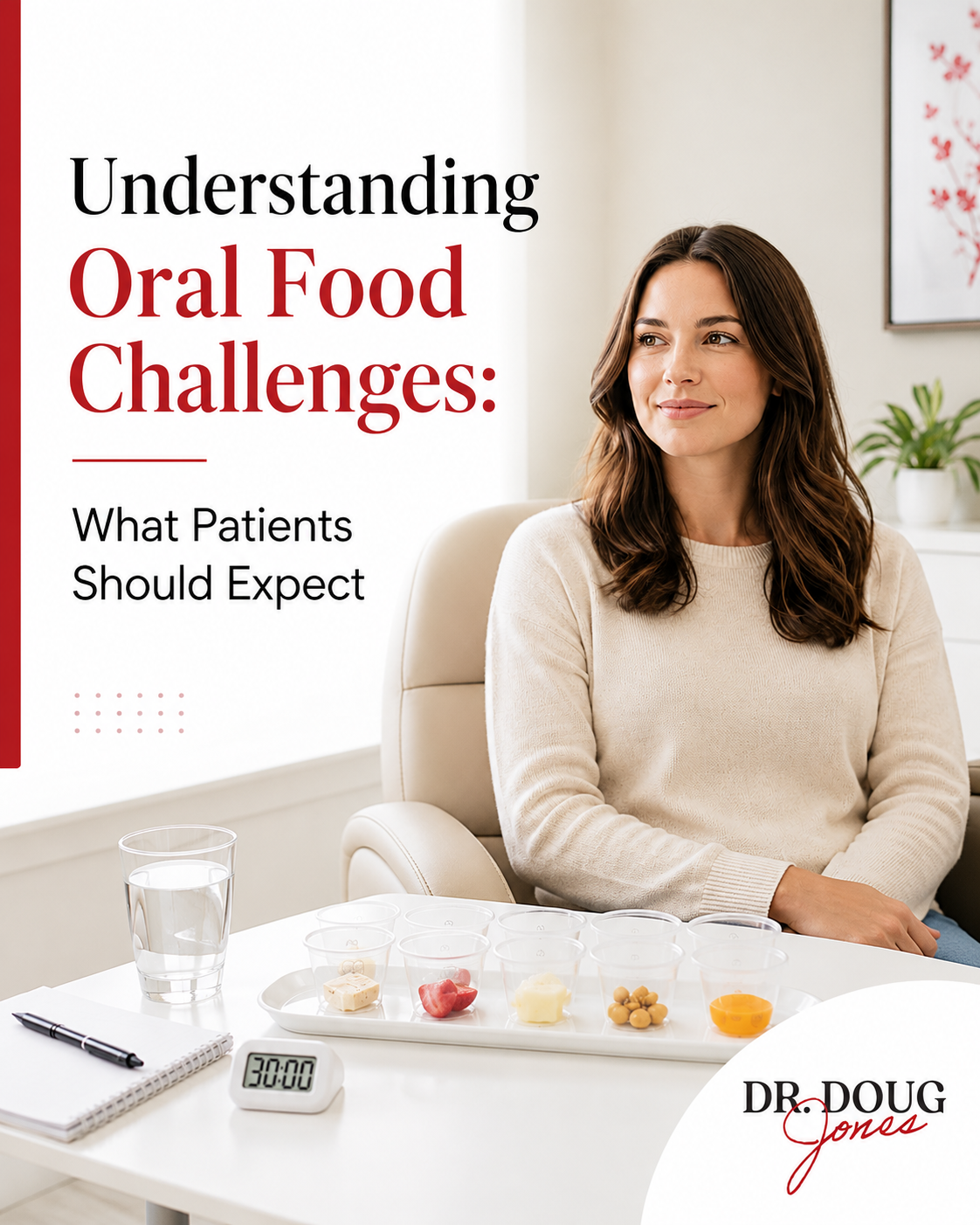
Food allergy testing has come a long way, but there are times when skin prick tests and blood tests alone cannot provide a definitive answer. A positive allergy test does not always mean someone will experience symptoms after eating a particular food, and a negative test doesn't always tell the whole story either.
When the diagnosis remains uncertain—or when an allergist believes a patient may have outgrown a food allergy—an oral food challenge (OFC) may be recommended. Considered the gold standard for diagnosing food allergies, an oral food challenge provides the most accurate way to determine whether a person can safely eat a suspected food.
Hearing the words "food challenge" can understandably make patients and parents feel anxious. Many worry that they're being asked to eat a food they've spent months or even years avoiding. However, an oral food challenge is a carefully planned medical procedure performed in a controlled clinical setting where trained healthcare professionals closely monitor every step.
Understanding why oral food challenges are performed, how they're conducted, and the safety measures involved can help patients feel more confident and prepared if one is recommended.
What Is an Oral Food Challenge?
.png)
An oral food challenge is a medically supervised procedure in which a patient consumes gradually increasing amounts of a suspected food allergen while being carefully monitored for signs of an allergic reaction.
Unlike skin prick testing or blood tests—which measure whether the immune system has developed sensitivity to a food—an oral food challenge evaluates something even more important:
How the body actually responds when that food is eaten.
Because it directly assesses real-world tolerance, an oral food challenge is widely recognized as the most reliable method for confirming or ruling out a food allergy.
These procedures are performed only when an allergist determines that the potential benefits outweigh the risks and that the patient's medical condition is stable enough for testing.
Why Your Allergist May Recommend an Oral Food Challenge
Not every patient with suspected food allergies requires an oral food challenge. Your allergist carefully considers your medical history, previous allergic reactions, physical examination, and allergy test results before deciding whether the procedure is appropriate.
An oral food challenge may be recommended when:
- Allergy test results are unclear or don't match your symptoms.
- A previous allergic reaction was mild, and it's uncertain whether the food was truly responsible.
- Blood test or skin prick test results suggest that the likelihood of a serious reaction has decreased over time.
- A child may have naturally outgrown a food allergy.
- An allergist wants to safely confirm whether a food can be reintroduced into the diet.
Rather than relying solely on laboratory results, an oral food challenge provides answers based on what happens when the food is actually consumed under expert medical supervision.
Why Allergy Tests Don't Always Tell the Whole Story
Many patients are surprised to learn that allergy testing has limitations.
A skin prick test or blood test can show that the immune system recognizes a particular food, but it cannot always predict whether eating that food will cause symptoms.
Some individuals have positive test results yet tolerate the food without any problems. Others may have low test values but still experience allergic reactions.
For this reason, allergists interpret test results alongside your medical history rather than relying on laboratory findings alone.
An oral food challenge helps bridge that gap by answering the question that matters most:
Can this person safely eat this food?
Who Is a Good Candidate for an Oral Food Challenge?
Every patient is evaluated individually, but oral food challenges are most commonly considered for people whose likelihood of experiencing a severe reaction is considered low enough that the procedure can be performed safely under medical supervision.
Candidates may include:
- Children whose allergy test results have improved over time.
- Patients with uncertain food allergy diagnoses.
- Individuals whose medical history and allergy testing do not clearly agree.
- Patients being evaluated before permanently eliminating a food from their diet.
- People whose allergist believes they may have developed tolerance to a previously avoided food.
On the other hand, an oral food challenge may be postponed if asthma is poorly controlled, an acute illness is present, or another medical condition increases the risk of complications.
The decision is always based on an individualized assessment performed by an experienced allergist.
Preparing for Your Oral Food Challenge
Preparation begins well before the day of the procedure.
Your allergy clinic will provide detailed instructions about how to prepare, and it's important to follow them carefully to help ensure accurate results and maximize safety.
Preparation may include:
- Following medication instructions provided by your allergist, including guidance about antihistamines if applicable.
- Avoiding the suspected food unless instructed otherwise.
- Informing the clinic if you've recently been ill or if your asthma or eczema has worsened.
- Eating only the foods recommended before your appointment.
- Wearing comfortable clothing, as the appointment may last several hours.
Many patients also find it helpful to bring books, electronic devices, schoolwork, or quiet activities, particularly when young children are undergoing the challenge, since observation periods between food doses can take time.
Although preparation may seem extensive, these steps help create the safest possible environment for accurate testing.
What Happens During an Oral Food Challenge?
Although every allergy clinic may have slightly different protocols, most oral food challenges follow the same carefully structured process.
When you arrive, a member of the healthcare team will review your medical history, confirm that you've followed the pre-test instructions, and assess whether you're well enough to proceed. Your vital signs may be checked, and your allergist will answer any remaining questions before the challenge begins.
The food being tested is then given in very small amounts. If no symptoms develop, the amount is gradually increased at scheduled intervals until a full serving—or another predetermined target amount—has been consumed.
After each dose, you'll be closely observed for any signs of an allergic reaction before receiving the next portion.
The process is intentionally slow. Taking a gradual approach allows the medical team to identify even mild symptoms early and respond promptly if necessary.
Depending on the food being tested and the clinic's protocol, the entire appointment may take several hours, including an observation period after the final dose.
How Safety Is Prioritized Throughout the Procedure
It's natural to feel nervous about eating a food you've been avoiding, but patient safety is the highest priority during every oral food challenge.
Unlike trying a food at home, an oral food challenge takes place in a controlled medical environment where trained healthcare professionals are prepared to recognize and treat allergic reactions immediately.
Emergency medications and equipment are readily available should they be needed, and your healthcare team monitors you closely throughout the procedure.
Because of these safeguards, oral food challenges have an excellent safety record when performed by experienced allergy specialists following established clinical guidelines.
What Symptoms Are Healthcare Providers Watching For?
Throughout the challenge, the medical team watches carefully for any changes that may indicate an allergic reaction.
Symptoms can vary from person to person and may include:
- Itching of the mouth or throat
- Hives or itchy skin
- Redness or flushing
- Swelling of the lips or face
- Stomach pain, nausea, or vomiting
- Coughing or wheezing
- Sneezing or nasal congestion
- Difficulty breathing
- Dizziness or lightheadedness
Not every symptom means the challenge will be stopped immediately. Your allergist evaluates the type, severity, and progression of any symptoms before deciding whether to continue or end the procedure.
If treatment becomes necessary, it is provided promptly according to established medical guidelines.
Understanding the Possible Outcomes
An oral food challenge generally results in one of three outcomes.
.png)
The Food Is Tolerated Successfully
If you complete the challenge without developing signs of an allergic reaction, your allergist may determine that the food can safely be added back into your diet.
You'll receive specific guidance on how and when to begin eating the food at home, including how often it should be incorporated into your regular diet if appropriate.
For many families, this outcome brings reassurance and allows unnecessary dietary restrictions to end.
A Mild Allergic Reaction Occurs
Some patients experience mild symptoms during the challenge, such as itching, hives, or stomach discomfort.
If this happens, your allergist may stop the challenge and treat the reaction. The results will help determine whether continued avoidance is recommended or whether additional evaluation may be needed in the future.
The Food Allergy Is Confirmed
If clear allergic symptoms develop after consuming the food, the challenge confirms that the allergy is still present.
Although this may feel disappointing, it provides valuable information that helps guide future treatment, emergency preparedness, dietary planning, and follow-up care.
Having a clear diagnosis also helps avoid unnecessary uncertainty and allows families to make informed decisions with confidence.
What Happens After the Challenge?
Even after the final food dose has been completed, you'll usually remain in the clinic for an observation period to ensure that no delayed symptoms develop.
Before you leave, your allergist will discuss the results, explain what they mean, and provide individualized recommendations.
Depending on the outcome, you may receive guidance about:
- Reintroducing the food into your regular diet.
- Continuing to avoid the food.
- Updating your allergy action plan.
- Carrying emergency medications if appropriate.
- Scheduling future follow-up visits.
Following these instructions carefully is an important part of long-term allergy management.
Common Misconceptions About Oral Food Challenges
Despite being a well-established medical procedure, oral food challenges are often misunderstood.
Myth: Oral food challenges are dangerous.
Fact: When performed by experienced allergy specialists in an appropriate medical setting, oral food challenges are considered safe and are conducted using carefully developed safety protocols.
Myth: A positive skin test means I don't need an oral food challenge.
Fact: Skin prick tests and blood tests measure allergic sensitization, not necessarily whether eating the food will cause symptoms. In some situations, an oral food challenge provides the most accurate diagnosis.
Myth: I can perform my own food challenge at home.
Fact: Foods that have previously caused allergic reactions should never be reintroduced without guidance from your allergist. Attempting a food challenge at home could place you at risk for a serious allergic reaction.
Myth: Failing an oral food challenge means nothing has changed.
Fact: Even when a challenge confirms that an allergy is still present, it provides important information that helps your allergist make informed recommendations about future care and the possibility of reevaluation as circumstances change.
Looking Beyond the Test
An oral food challenge is more than a diagnostic procedure—it's an opportunity to make informed decisions based on evidence rather than uncertainty.
Whether the challenge confirms an allergy or shows that a food can safely be reintroduced, the results help eliminate guesswork and provide a clearer path forward.
If you're interested in learning more about how food allergies are diagnosed and how they may change over time, our article on Can You Outgrow a Food Allergy? Understanding Food Allergy Resolution explains why some individuals develop tolerance and how allergists determine when reevaluation may be appropriate.
Conclusion
An oral food challenge is one of the most valuable tools available in allergy care. By evaluating how your body responds to a food under carefully controlled medical supervision, it provides answers that skin prick tests and blood tests alone cannot.
Although the idea of eating a food you've been avoiding may feel intimidating, understanding what to expect can make the experience less stressful. Every step of the procedure is designed with patient safety in mind, from careful screening before the challenge to close monitoring throughout the test.
Whether an oral food challenge confirms a food allergy or shows that a food can be safely reintroduced, the results provide clarity that can guide future treatment, reduce unnecessary dietary restrictions, and improve quality of life.
If your allergist recommends an oral food challenge, don't hesitate to ask questions about the process, how to prepare, and what the results may mean for your long-term care. Working together with your healthcare team can help you move forward with greater confidence and a clearer understanding of your food allergies.
Frequently Asked Questions
What is the purpose of an oral food challenge?
An oral food challenge is performed to determine whether a person can safely eat a suspected food allergen. It is considered the most accurate method for confirming or ruling out a food allergy when medical history and allergy test results are inconclusive.
How long does an oral food challenge take?
Most oral food challenges take several hours to complete. The exact length depends on the type of food being tested, the number of doses given, and the observation period after the final dose.
Is an oral food challenge safe?
Yes. When performed by a board-certified allergist in a medical setting, oral food challenges are generally very safe. Patients are closely monitored throughout the procedure, and medications and emergency equipment are immediately available if a reaction occurs.
Can I do an oral food challenge at home?
No. If you've been advised to avoid a food because of a suspected or confirmed food allergy, you should never attempt to reintroduce it on your own. Oral food challenges should only be performed under the supervision of a qualified allergist.
What happens if I have an allergic reaction during the challenge?
If symptoms develop, the medical team will stop the challenge and provide appropriate treatment based on the severity of the reaction. Because patients are monitored throughout the procedure, allergic reactions can be recognized and managed promptly.