
Board-Certified Allergist & Immunologist
Blog
Podcast
Podcast
The Protective Brain: Why the Body Can Keep Responding to Past Threats
Explore how the protective brain responds to danger, learns from past experiences, and influences symptoms, safety behaviours, and chronic illness.

November 26, 2026
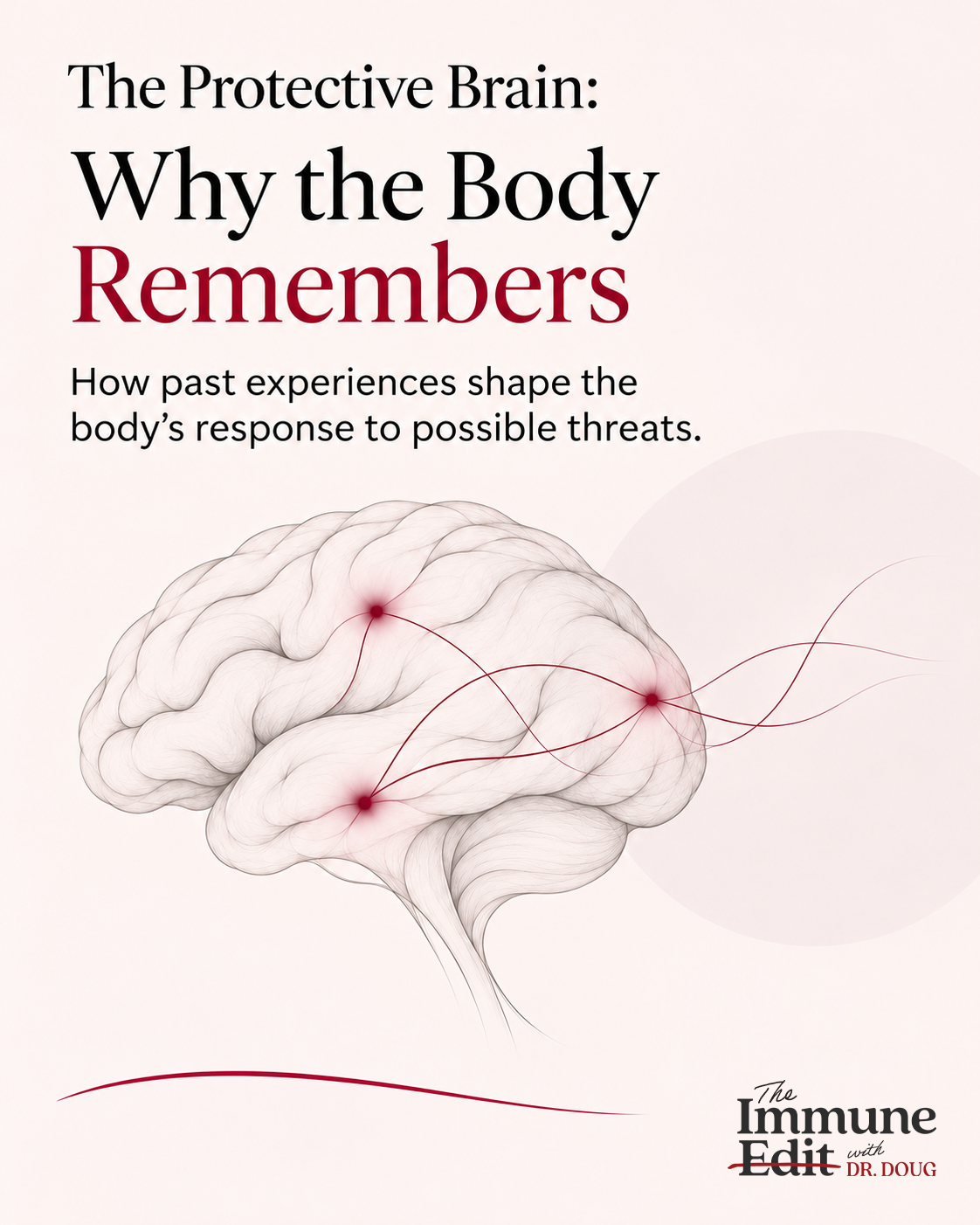
The body can react to a possible threat before the mind has time to understand what is happening. A racing heart, sudden nausea, dizziness, muscle tension, or an urge to escape can appear almost instantly. Even when part of us understands that we may be safe, another part is already preparing for danger.
This response is not necessarily irrational. It reflects the way the brain and nervous system are designed to protect us.
In this episode of The Immune Edit, Dr. Doug Jones explores the protective brain: the interconnected systems that detect possible danger, interpret signals from the body and environment, draw on previous experiences, and prepare us to respond. These systems are essential to survival, but their protective responses can sometimes extend beyond the original threat.
Understanding this process requires an important distinction: not every symptom is caused by the brain, and fear does not explain food allergies, mast cell disease, ME/CFS, dysautonomia, or other chronic illnesses. However, the nervous system's response to illness and previous experiences can influence how people interpret sensations, approach uncertainty, and make decisions about everyday life.
What Is the Protective Brain?
The protective brain is not one specific structure or a single switch that controls fear. It is a useful way of describing networks involved in detecting potential threats, interpreting information from inside and outside the body, remembering previous experiences, and preparing the body to respond.
Its first priority is survival, not perfect accuracy.
Imagine hearing movement in the bushes. The brain does not wait for certainty about whether the sound came from a dangerous animal or something harmless. It may prepare the body to respond before the situation is fully understood. Mistaking something harmless for a threat can cost energy, but failing to recognize a genuine threat can have much greater consequences.
This is why the protective system is capable of producing false alarms.
Importantly, a false alarm does not mean the physical response is imaginary. A racing heart, sweating, nausea, dizziness, altered breathing, muscle tension, and the urge to escape can all be genuine experiences.
The more useful question is not whether the response is real, but what it is responding to. Sometimes the danger is present and biological. Sometimes the response is connected to a remembered experience. In many situations, both may be involved.
How Real Experiences Can Shape Future Responses
Consider a child who experiences a severe allergic reaction after eating a cookie. The reaction is real. The child may develop hives, experience breathing difficulties, require epinephrine, and need emergency medical care.
The family receives appropriate instructions: avoid the allergen, carry epinephrine, and carefully read food labels. These are essential safety measures, not signs of excessive anxiety.
However, the nervous system does not experience the event as a neatly organized medical lesson about a specific allergen. It experiences a frightening situation involving physical symptoms, uncertainty, frightened adults, emergency treatment, and the possibility of serious harm.
Over time, the child's protective boundaries may expand. Avoiding the confirmed allergen may gradually become avoiding bakery items, restaurants, food prepared outside the home, school trips, sleepovers, or travel.
Eventually, even foods with no meaningful connection to the original allergen may begin to feel unsafe.
This illustrates an important distinction: the initial boundary protects against a genuine biological threat, while later restrictions may also reflect an attempt to avoid uncertainty and the possibility of another frightening experience.
That does not mean every additional precaution is unnecessary. It means each one deserves careful consideration in the context of the person's actual allergy and medical needs.
Rather than dismissing a family as irrational, it is more helpful to ask which precautions are still necessary for the confirmed allergy and which may have expanded because uncertainty itself has become difficult to tolerate.
Why the Brain Generalizes Protection
The protective brain learns through association. When a particular experience is connected with danger, the cues surrounding that experience can begin to trigger a protective response in the future.
However, the brain does not always learn the exact boundaries of the original threat. Its response can generalize to situations that resemble the original experience, even when the circumstances are different.
For example:
- A frightening food reaction may make eating feel unsafe more generally.
- A serious medication reaction may make future medications feel threatening.
- A post-exertional crash may lead someone with ME/CFS to anticipate the physical consequences of activity.
- A negative experience with a healthcare professional may make another medical appointment feel unsafe before the new clinician has even spoken.
These responses are not character flaws. They can develop through direct experience, observation, or information received from other people.
Social media can also influence what people notice and perceive as threatening. Repeated exposure to alarming stories and strongly worded health claims may make certain risks more prominent in someone's attention. This does not mean social media causes the underlying illness; rather, it can contribute to the information the nervous system uses when evaluating possible danger.
The protective brain is constantly looking for patterns. Unfortunately, not every pattern presented online is accurate or balanced.
The Brain's Threat Network Is More Than the Amygdala
The amygdala is often described as the brain's fear center. Although it plays an important role in detecting and learning about biologically significant events, including threats, the process involves several interconnected brain regions.
Other important areas include:
- The hippocampus: Helps provide context to an experience, including where it happened and whether the present situation is similar to a previous one.
- The insula: Helps integrate information from inside the body, including sensations related to heartbeat, breathing, nausea, and temperature.
- Prefrontal regions: Participate in interpretation, regulation, and learning that a previously threatening cue may now be safe.
Together, these systems help the brain interpret information and make predictions under uncertainty.
For example, after experiencing a frightening heart-related symptom, someone may become particularly attentive to every skipped beat. A person who has repeatedly experienced symptoms after eating may pay close attention to sensations following meals. Someone who has experienced delayed worsening after activity may begin anticipating those consequences before exertion starts.
Attention is part of the protective response. It brings possible threats into focus, but it does not establish whether a sensation is caused by an active biological condition, a learned response, or both.
That distinction requires careful evaluation.
Why This Matters in Chronic Illness
The protective brain becomes particularly important when discussing chronic illness because some protective behaviors are responses to genuine and ongoing physical limitations.
A person with ME/CFS who experiences post-exertional malaise is not simply afraid of exercise. Exertion can trigger delayed, multi-system symptom worsening that is biologically meaningful. Pushing through these symptoms can be harmful.
Similarly, someone with mast cell disease who has experienced reactions to medications may have legitimate reasons to approach new prescriptions carefully. A person with dysautonomia who becomes presyncopal in the shower may need practical measures such as a shower chair, temperature adjustments, and appropriate medical treatment—not a lecture about positive thinking.
Caution can be an appropriate response to real physiology.
At the same time, not every protective boundary remains equally accurate forever. Some restrictions may expand beyond what the underlying medical condition requires, and examining them can be useful when done carefully.
The goal is not to label every behavior as excessive or assume that every concern is psychological. It is to understand what is happening biologically while also considering how previous experiences influence the person's response.
Moving Beyond the Medical-versus-Psychological Debate
One of the least useful questions in complex illness is whether something is medical or psychological. The distinction is often too simplistic to explain what a person is experiencing.
A more helpful approach considers three interconnected layers:
1. The underlying biology
What is happening physically? Is there an active allergy, an immune-related condition, dysautonomia, post-exertional malaise, a medication side effect, or another biological process that needs attention?
2. The nervous system's response
How has the nervous system learned to respond to those physical experiences? What sensations, situations, or cues now trigger protective responses?
3. The meaning and behavior that develop around the experience
How has the person interpreted what happened? Have certain foods, activities, medications, or situations become associated with danger? Have new precautions or restrictions developed?
These layers interact, but they are not interchangeable.
Treating the underlying biology matters. Supporting the nervous system matters. Addressing behaviors that may have developed around frightening experiences can also matter.
None of these approaches cancels out the others.
Why Reassurance Alone May Not Be Enough
When someone is afraid to eat a particular food, a clinician might explain that the available test results are reassuring. That information can be medically important, but it may not immediately change how the person responds.
The protective system is not simply asking whether a clinician believes the food is safe. It is responding to previous experiences and anticipating whether the same pattern could happen again.
This helps explain why reassurance alone may not be effective and why dismissing a patient's concerns can be harmful.
Information can help the brain update its understanding, but safety learning also involves experience.
The goal is not to erase an old fear memory or force an alarm into silence. Instead, new learning can develop alongside previous learning. With appropriate guidance and tolerable experiences, the nervous system may gradually become less likely to interpret every similar cue as the original threat.
Building Safety Through Individualized Experiences
The process of developing new safety learning needs to be gradual, meaningful, and appropriate to the person's medical condition.
Depending on the situation, this may involve:
- Medically supervised food challenges: When clinically appropriate, a supervised challenge can help clarify whether a suspected food allergy is present.
- Carefully planned food introductions: Introducing foods in a clear, individualized manner may help someone address food-related uncertainty when medically appropriate.
- Thoughtful medication planning: For some people who experience medication side effects or sensitivities, clinicians may consider starting with a lower dose and gradually adjusting it. This must be individualized and guided by the treating clinician. It is not a substitute for appropriate precautions in someone with a true medication allergy.
- Physiologically appropriate activity: For people with ME/CFS, activity must respect their current energy limits and avoid pushing through post-exertional malaise.
- Planned return to everyday situations: For someone with food-related fears, reviewing a restaurant menu and developing an appropriate safety plan may help make eating outside the home more manageable.
The pace matters. An experience that overwhelms someone may reinforce the original sense of danger. On the other hand, if safety is attributed entirely to a particular control or ritual, the learning may not extend to other situations.
The next step should be meaningful enough to provide useful information while remaining tolerable for the individual.
This is not about forcing exposure or proving that someone can overcome fear through willpower. It is about finding a medically appropriate next step that respects the person's actual physiology.
When Protection Becomes Restriction
One of the most difficult aspects of this process is recognizing that necessary safety measures and expanding restrictions can look similar from the outside.
Avoiding a confirmed food allergen is an essential safety measure. Avoiding numerous unrelated foods because any sensation after eating feels threatening may indicate that restrictions have expanded beyond the original allergy.
Resting during an ME/CFS crash is protection. Assuming that every form of meaningful activity will always be impossible may be a conclusion worth examining carefully, without disregarding the person's physiological limitations.
Declining a medication after a serious reaction may be a sensible decision. However, treating every medication as permanently dangerous because of previous side effects may limit access to potentially useful treatment.
There is no universal rule for distinguishing these situations. Each requires an understanding of the person's medical history, current symptoms, and individual circumstances.
This is where shared decision-making becomes essential. Listening, communication, validation, and appropriate clinical expertise help patients and healthcare professionals determine which precautions remain necessary and where carefully considered changes may be possible.
The central question is whether protection is helping someone live safely or gradually making life smaller than their medical condition requires.
What Does Moving Forward Look Like?
Working with the protective brain begins with understanding rather than judgment.
First, people should not be insulted or dismissed for responses that have developed through real experiences. Their reactions have a history, and those experiences deserve to be taken seriously.
Second, the underlying biology needs to be evaluated honestly. Protection cannot be appropriately calibrated if a genuine medical risk is dismissed or exaggerated.
Third, the focus can shift towards identifying the smallest useful next step—one that is appropriate for the person's condition and that they can realistically tolerate.
For one family, this might mean eating a familiar meal outside the home with an appropriate allergy safety plan. For someone experiencing restricted eating, it might involve reconsidering one nutritionally useful food with suitable clinical guidance. For someone with medication sensitivities, it might mean reviewing what actually happened during previous reactions rather than automatically ruling out every medication. For someone living with chronic illness, it may mean finding ways to participate in everyday life while respecting current physical limitations.
Progress does not always look dramatic. Sometimes it is one less check, one additional food, one appointment that requires less preparation, or one decision made with the help of evidence rather than panic or pressure.
The aim is not to eliminate all protection or promise that nothing bad will ever happen. It is to develop a more accurate understanding of risk and become more comfortable navigating uncertainty without allowing fear to make every decision.
The Takeaway: Protection Is Not Weakness
The protective brain is an essential part of how we respond to the world. It can prepare the body for danger before conscious interpretation catches up, learn from frightening experiences, and generalize protective responses to situations that resemble previous threats.
But a real physical response does not automatically prove that the original danger is present now.
Understanding this distinction does not mean dismissing symptoms or treating chronic illness as a psychological problem. It means considering the underlying biology, the nervous system's learned responses, and the behaviors that develop around those experiences together.
Necessary safety and expanding restriction are not the same. Information helps the brain understand, while experience can help it update. And meaningful progress begins with a realistic next step that the body can actually tolerate.
The brain learns protection. It predicts, the body prepares, and sometimes the response continues long after the original event.
Understanding that process can help patients and clinicians move forward—not by abandoning caution, but by making protection more accurate.
Frequently Asked Questions
What is the protective brain?
The protective brain is a term for interconnected brain and nervous system networks that detect possible danger, interpret signals from the body and environment, draw on previous experiences, and prepare the body to respond.
Why can the body react to danger before the mind understands it?
The brain's protective systems can respond to possible threats before conscious interpretation is complete. This allows the body to prepare quickly, even when the situation has not yet been fully understood.
Does the protective brain mean symptoms are psychological?
No. Physical symptoms can reflect active biological conditions, learned protective responses, or a combination of both. The concept of the protective brain does not mean that conditions such as food allergy, ME/CFS, mast cell disease, or dysautonomia are caused by fear.
Why can a frightening experience make unrelated situations feel unsafe?
The brain can learn through association and generalize protective responses beyond the original experience. As a result, situations that resemble a previous frightening event may trigger caution or a sense of danger, even when the current circumstances are different.
What is safety learning?
Safety learning refers to developing new experiences and information that help the brain recognize when a previously threatening cue may no longer represent the same danger. It does not necessarily erase the original learning; instead, new learning can develop alongside it.
How can someone work with the protective brain?
The approach depends on the person's medical condition and individual circumstances. It may involve accurate medical evaluation, appropriate safety planning, gradual and medically guided experiences, and support in addressing restrictions that may have expanded beyond the original threat.
Medical Disclaimer: This article is for educational purposes only and does not constitute medical advice, diagnosis, or treatment. It is not a substitute for professional care from a qualified healthcare practitioner. Do not change medication doses, introduce suspected allergens, alter activity levels, or discontinue prescribed treatment without appropriate medical guidance. Individual care decisions should be made with a qualified healthcare professional.